

Disclaimer:
This is a popular science article, which aims to popularize the relevant knowledge in the field and promote science communication.
The video, pictures, text and other materials used in this article, if involved in the copyright of works, please contact us in a timely manner, we will properly handle according to law.
In addition, if there are errors in the content of the article, or inconsistent with the original journal article point of view, conclusion, also welcome to inform us, we will be the first time to modify, delete and so on.
At the same time, we warmly welcome scientific researchers and science enthusiasts in related fields to contribute, recommend, or discuss cooperation to jointly promote the development of industrialization.
01 Introduction
On April 7, 2026, the 1972nd meeting of the Judicial Committee of the Supreme People's Court deliberated and approved the "Interpretation of the Supreme People's Court on the Application of Punitive Damages in Civil Dispute Cases Involving Intellectual Property Infringement" (Judicial Interpretation [2026] No. 7), and it was officially released on April 17. It will come into effect on May 1, 2026.
[New Regulations Update] The new regulations on punitive damages for intellectual property rights have come into effect. At the same time, the old judicial interpretation (Judicial Interpretation [2021] No. 4) issued in 2021 has been officially abolished. The new regulations focus on the pain points of "low compensation, difficult evidence presentation, and ambiguous determination" in intellectual property rights protection, and detail the compensation standards, lower the threshold for protection, and strengthen infringement punishment. This marks that China's intellectual property protection has entered a new stage of "strict protection and high compensation".
02 Background of the New Regulations Implementation
In recent years, the number of intellectual property cases in China has continued to increase, with prominent issues such as malicious infringement, repeated infringement, and large-scale infringement. After the implementation of the old version of the punitive compensation interpretation in 2021, courts across the country concluded 1,471 related cases within five years, and the annual compensation amount reached 1.8 billion yuan in 2025. Although certain achievements have been made, there are still three core pain points in practice:
1.It is difficult to determine the quantity:the legal compensation cannot be used as the base for punitive damages or the standard for calculating the infringer's profits, and this lack of clarity has resulted in a relatively low amount of compensation.
2.Subjective determination is vague:the criteria for determining "intentional" and "serious circumstances" are not detailed enough, leaving a large degree of discretion, and thus the success rate of rights protection is limited.
3.Weakened burden of proof:when the infringing party refuses to provide financial records, it becomes extremely difficult for the rights holder to present evidence, making it hard to substantiate the claim for a large amount of compensation.
To address these issues, the Supreme People's Court has drawn on five years of judicial experience and, in light of the demands of industrial development, has revised and introduced new regulations for 2026. The core objective is to "clarify standards, lower thresholds, strengthen penalties, and balance the burden of proof", providing clearer and more powerful judicial grounds for intellectual property rights protection.
03 Key Points of the Core Content of the New Regulations
1.Applicable Premise: "Intention + Severe Circumstances" Dual Requirements
The plaintiff is claiming punitive damages. To do so, they must provide evidence to prove that the defendant intentionally infringed upon intellectual property rights and that the circumstances were serious. Both elements are necessary.
2. "Intentional" determination: Direct determination for 7 types of circumstances (new additions + refinement)
The new regulation makes it clear that the defendant shall be deemed to have intentionally committed the infringement unless the party concerned has evidence to the contrary:
(1) continuing to commit the infringement after the plaintiff has given effective notice;
(2) the defendant and the plaintiff have a relationship (such as the legal representative, the actual control person overlap) , should know the existence of the right to infringe;
(3) contact with the plaintiff's intellectual property rights (such as licensing, cooperation, transfer) , the subsequent unauthorized infringement;
(4) falsification, destruction or concealment of evidence of infringement;
(5) recommencement of the same or similar infringement after a settlement with the plaintiff;
(6) taking the infringement of intellectual property as a business;
(7) other circumstances under which intent may be identified.
3. "Serious circumstances" determination: 7 types of situations should be considered as "serious" (lowering the threshold for determination)
The new regulation has changed the old version of "can be recognized" to "must be recognized", directly clarifying the standards, including:
(1) Large scale of infringement, long duration, huge profit amount;
(2) Infringing on core intellectual property rights, seriously affecting the market share of the rights holder;
(3) Repeated infringement, multiple infringements;
(4) Refusal to fulfill the evidence preservation ruling or the effective judgment;
(5) Infringement behavior endangering public interests;
(6) Engaging in the business of infringing intellectual property rights;
(7) Other serious circumstances.
4. Compensation base: Clearly define the calculation rules. Statutory compensation cannot be used as the base.
The base amount for punitive damages shall be determined in the following order:
(1) Actual losses: The actual losses suffered by the right holder due to the infringement;
(2) Illegal gains: The profits obtained by the defendant from the infringement (generally calculated based on business profits, or sales profits if the infringement is the main business);
(3) License usage fees: When the first two items are difficult to calculate, refer to a reasonable license usage fee.
⚠️ Key point clarification: The statutory compensation amount cannot be used as the base for calculating punitive damages.
5. Evidence-providing Rules: Strengthen the burden of proof on the infringing party, and if they refuse to provide evidence, the court shall directly accept the plaintiff's claims.
The court may order the defendant to provide relevant accounting books and materials related to the infringement; if the defendant fails to provide them without valid reasons or provides false materials, the court may directly determine the base amount based on the plaintiff's claims and the evidence on file, and may also pursue legal responsibility.
6. Compensation multiplier: within the range of 1 to 5 times. It can be calculated as a non-integer. Reasonable expenses will be calculated separately.
(1) Multiplier Range: Above 1 time and below 5 times. Considering the degree of fault and the severity of the circumstances, non-integer multipliers (such as 2.5 times) can be determined;
(2) Total Upper Limit: The maximum compensation amount is 5 times the base amount;
(3) Reasonable Expenses: The lawyer fees, notary fees, etc. paid by the right holder to stop the infringement will be calculated separately outside the 5 times total amount.
7. Procedural Rules: Relax the time limit for requests. Requests can be made after the conclusion of the first-instance debate.
The plaintiff may add a claim for punitive damages before the conclusion of the "first-instance court debate", and the court shall grant such request.
If new requests are added during the second instance, the court may conduct mediation. If mediation fails, the request will not be supported.
If no punitive damages are requested and the party still refuses to do so after being advised by the court, they shall not be able to file a new lawsuit based on the same facts in the future.
8. Comparative Analysis of the New and Old Judicial Interpretations (Judicial Interpretation No. 7 [2026] vs Judicial Interpretation No. 4 [2021])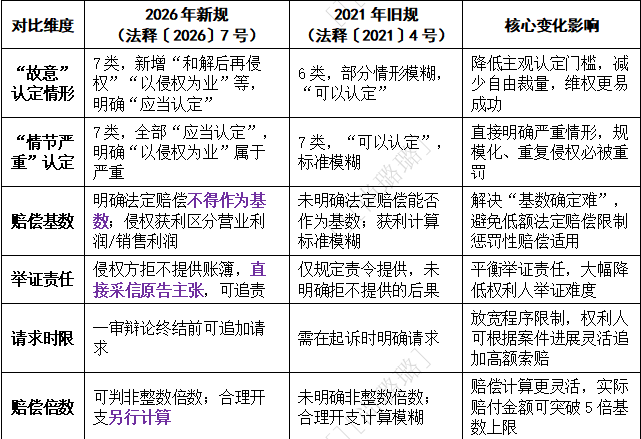
04 Key Interpretation of New Regulations: Directly Addressing the Pain Points of Rights Protection and Unleashing Three Major Benefits
1. BONUS 1: “Zero Tolerance” for malicious infringement, with top five times compensation becoming the norm.
The new regulations refine the criteria for determining“Intentional” and“Serious circumstances.” Such acts as re-infringement after reconciliation, taking infringement as an occupation, and repeated infringement are directly identified as malicious serious infringement, and the court may directly impose 5 times compensation, completely change the current situation of“Low cost of infringement, high cost of rights protection”.
2. Bonus Point 2: The difficulty of providing evidence has been significantly reduced, enabling rights holders to have greater confidence in their ability to defend their rights.
In the past, the difficulty in protecting rights lay in the fact that the infringing party controlled the financial data and refused to provide it. In such cases, the rights holder would have difficulty proving the infringement profits. The new regulation clearly states that if the infringing party refuses to provide the account books, the court can directly accept the plaintiff's claim, which is equivalent to shifting the burden of proof to the infringing party. As a result, the rights holder no longer needs to spend a large amount of cost to obtain the infringement data.
3. Bonus Point 3: The calculation of compensation has become clearer, and the actual payout amount has significantly increased.
The new rules make it clear that statutory compensation can not be used as a base figure to avoid the application of low statutory compensation to limit punitive damages. At the same time, reasonable expenses shall be calculated separately beyond the base figure of five times, it means that in addition to the maximum 5 times the base amount of compensation, the right holder can also receive full compensation for legal fees, notary fees and other rights protection costs. The actual amount of compensation may be far more than 5 times the base amount.
05 Conclusion: Intellectual property protection has entered the "harsher penalties era", and enterprises need to upgrade their compliance measures.
The implementation of the new regulation on punitive damages for intellectual property rights in 2026 is an important measure to strengthen the protection of intellectual property rights in our country, from“Moderate compensation” to“Severe punishment”, from“Fuzzy cognizance” to“Clear standard”, from“Imbalance of proof” to“Balance of responsibility”, the judicial protection of intellectual property rights will be enhanced in an all-round way.
For enterprises, they need to take two major measures:
(1) strengthen compliance management: check its own intellectual property risks, put an end to malicious infringement and repeated infringement, and avoid touching the“Intentional + serious” red line;
(2) improve the layout of rights: strengthen the protection of their own intellectual property rights (patents, trademarks, copyrights, trade secrets, etc.) , retain evidence of infringement, make good use of the new rules of proof, and effectively protect their rights.