

This is a popular science article, which aims to popularize the relevant knowledge in the field and promote science communication.
The video, pictures, text and other materials used in this article, if involved in the copyright of works, please contact us in a timely manner, we will properly handle according to law.
In addition, if there are errors in the content of the article, or inconsistent with the original journal article point of view, conclusion, also welcome to inform us, we will be the first time to modify, delete and so on.
At the same time, we warmly welcome scientific researchers and science enthusiasts in related fields to contribute, recommend, or discuss cooperation to jointly promote the development of industrialization.
Against the challenge of poor self-repair capacity of bone defects and severe systemic toxic side effects induced by systemic administration of Yoda1, a joint research team led by Professor Jiankang He from Xi’an Jiaotong University and Professor Wei Wang from the Second Affiliated Hospital of Xi’an Jiaotong University has innovatively fabricated polycaprolactone (PCL) microfibrous scaffolds via electrohydrodynamic (EHD) 3D printing. Polydopamine (PDA) coating was applied to load Yoda1 for sustained local drug release. Meanwhile, the Piezo1-mediated osteogenic regulatory pathway was elucidated. Relying on dual mechanisms of direct osteogenic induction and immune microenvironment remodeling, the composite scaffold efficiently accelerates neo-bone regeneration, offering a simple, cost-effective novel strategy for precision-targeted repair of clinical bone defects.
The relevant research was published in ACS Applied Materials & Interfaces, entitled Yoda1-Loaded Microfibrous Scaffolds Accelerate Osteogenesis through Piezo1-F-Actin Pathway-Mediated YAP Nuclear Localization and Functionalization.

Highlights: Innovation and Breakthrough
- Novel Localized Drug Delivery System: An electrohydrodynamically printed PCL microfiber-polydopamine composite drug-loaded scaffold was constructed to realize site-specific delivery of Yoda1. The fabrication process is simple and low-cost, eliminating drug deactivation caused by high-temperature processing. Sustained drug release can be maintained for up to 21 days, completely eliminating off-target systemic toxicities associated with systemic Yoda1 administration. Polydopamine simultaneously improves the surface bioactivity and mechanical strength of the scaffold; the optimal safe drug loading concentration was screened to perfectly match the requirements of bone defect repair scaffolds.
- Novel Molecular Mechanism Elucidation: The composite scaffold markedly enhances adhesion and differentiation of MC3T3-E1 pre-osteoblasts in vitro. The complete molecular cascade is clarified as follows: Yoda1 activates Piezo1 ion channels, triggers F-actin polymerization to drive YAP nuclear translocation, and histone lysine acetylation relaxes chromatin structure, ultimately upregulating the core osteogenic protein Collagen I (COL-I). This study complements and refines the theoretical framework of Piezo1-mediated mechanotransduction in osteoblasts.
- Bone Immunomodulatory Function: In vivo critical-sized calvarial defect models verified that sustained local Yoda1 release polarizes macrophages toward the reparative M2 phenotype and suppresses local inflammatory responses. In vitro co-culture assays further confirmed that the scaffold exerts synergistic effects on both osteoblasts and macrophages, facilitating bone defect repair via dual pathways of osteogenic promotion and immune microenvironment reprogramming.
WHAT: Research Content
This study addresses three major bottlenecks: severe systemic toxicity of systemic Yoda1 delivery, inherent drawbacks of conventional bone repair scaffold manufacturing, and unclear molecular & immune regulatory mechanisms governing Piezo1-mediated osteogenesis. An EHD 3D-printed PCL-PDA scaffold loaded with Yoda1 was fabricated to achieve long-term localized drug delivery. Through in vitro cellular assays, pathway inhibition validation, and in vivo rat bone defect models, we validated that the scaffold activates the Piezo1-dependent osteogenic signaling cascade and drives reparative M2 macrophage polarization. Synergistic osteogenic and immunomodulatory effects collectively promote robust bone regeneration.
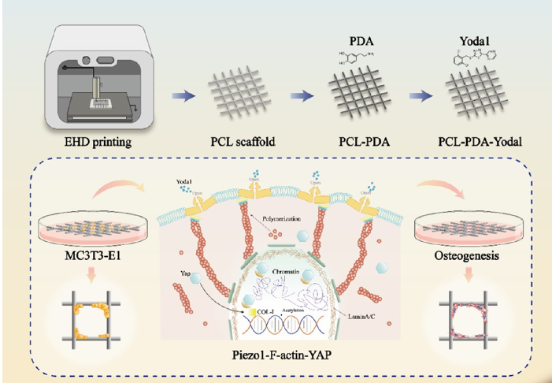
The Solution: the technologicaledge
1. Fabrication of Functional Drug-Loaded Scaffolds & Optimized Drug Administration Strategy
Electrohydrodynamic molding was utilized to construct porous microfibrous frameworks with micrometer-scale pores. Polydopamine interfacial modification enables stable drug immobilization, resolving the long-standing industry limitation that thermosensitive bioactive drugs cannot be integrated into melt-fabricated 3D-printed scaffolds. The scaffold exhibits gradual, steady drug release kinetics matching the medication demands of early-stage bone defect repair. Surface modification endows the scaffold with load-bearing mechanical properties and favorable biological interfaces. Multiple cytotoxicity evaluations confirmed the biosafety of the optimized drug loading dosage. Local targeted delivery fundamentally eliminates systemic adverse reactions induced by systemic medication.
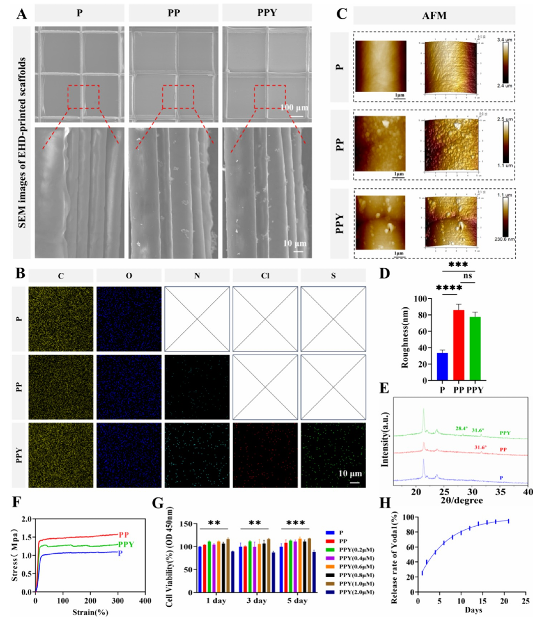
2. In Vitro Cellular Assays Clarify Osteogenic Regulatory Logic & Supplement Mechanotransduction Theory
Compared with control groups, Yoda1-loaded scaffolds significantly boost spreading, adhesion, and mineralized nodule formation of osteoblasts. Stepwise pathway inhibition assays delineated the hierarchical regulatory cascade: activation of mechanosensitive Piezo1 channels initiates cytoskeleton remodeling and facilitates YAP nuclear translocation. Chromatin relaxation mediated by histone acetylation is indispensable for full transcriptional activation of osteogenic genes. This research resolves ambiguities surrounding YAP-mediated osteogenic regulation in prior literature and enriches the discipline of bone mechanobiology.
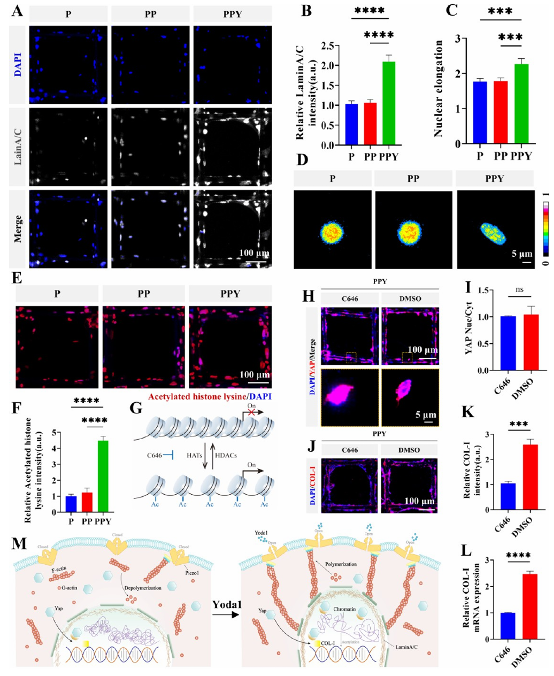
3. Superior In Vivo Regenerative Performance Driven by Remodeled Immune Microenvironment
Implantation experiments using rat critical-sized calvarial defects demonstrated that the drug-loaded scaffold efficiently redirects macrophage phenotypic transition, suppresses persistent local inflammation, and generates a pro-regenerative microenvironment. Co-culture systems validated positive crosstalk between immune cells and osteoblasts. In vivo quantitative detection revealed a significantly higher volume of newly formed bone and superior trabecular microstructure in the Yoda1-scaffold group versus all control groups. Combined direct osteogenic induction and immune modulation collectively achieve efficient repair of large bone defects.
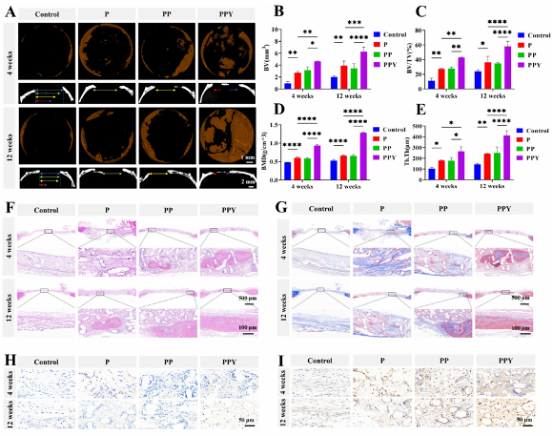
Conclusions
This work establishes an electrohydrodynamic 3D-printed porous PCL-polydopamine scaffold loaded with Yoda1. The microstructural design enables steady 21-day localized drug release, fundamentally eliminating off-target systemic toxicity of Yoda1 systemic administration. In vitro experiments delineate the complete Piezo1-F-Actin-YAP-histone acetylation signaling axis governing osteoblast differentiation, advancing the mechanistic understanding of bone mechanotransduction. In vivo animal studies confirm that the scaffold modulates macrophage polarization and ameliorates inflammatory microenvironments at defect sites, enabling robust regeneration of critical-sized bone defects through synergistic osteogenic and immunomodulatory effects. This biomimetic drug-loaded scaffold fabrication strategy is facile, cost-effective, and highly translatable, representing a viable novel candidate for clinical bone defect repair.